

Global Pharmaceutical Unit Dose Packaging Market to Hit USD 9.8 Bn by 2036 | Amcor, Gerresheimer
Pharmaceutical Unit Dose Packaging Market Size
UK pharmaceutical unit dose packaging demand rises 10.3% CAGR, fueled by NHS safety protocols, centralized dispensing, and growing chronic disease cases
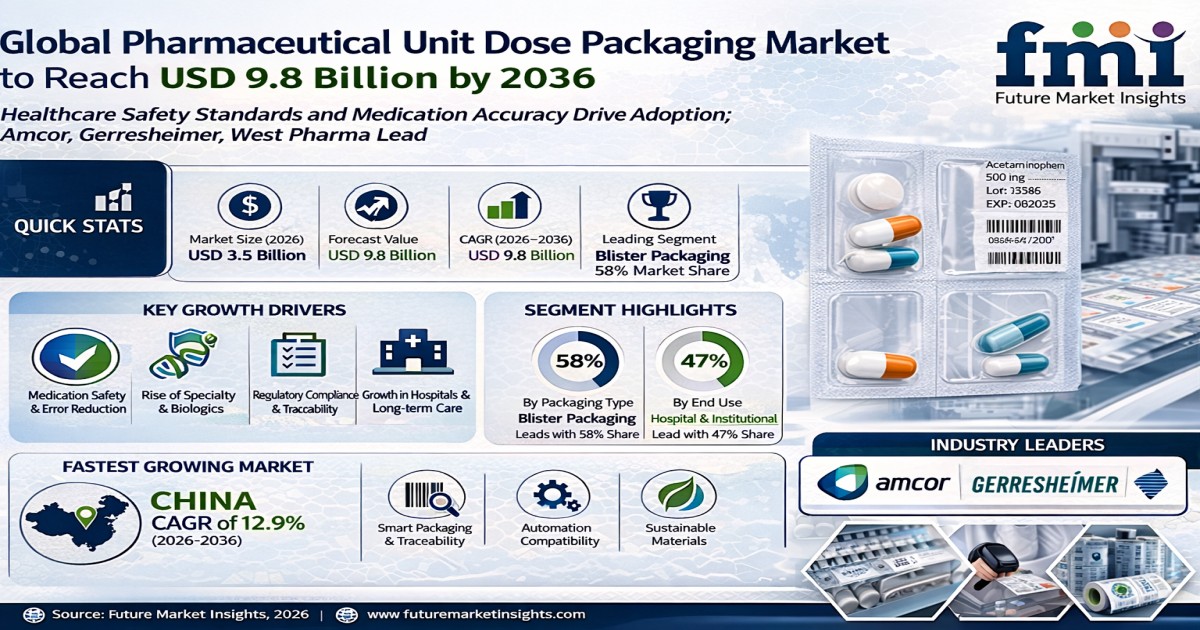
NEWARK , DE, UNITED STATES, March 30, 2026 /EINPresswire.com/ -- The global pharmaceutical unit dose packaging market is projected to grow from USD 3.5 billion in 2026 to USD 9.8 billion by 2036, registering a CAGR of 10.8% over the forecast period. This growth reflects a structural shift in pharmaceutical delivery systems toward precision dosing, enhanced patient safety, and regulatory compliance. Unit dose packaging is increasingly becoming a critical component of modern healthcare infrastructure, ensuring accurate medication administration, minimizing contamination risks, and supporting traceability across hospital and pharmacy networks.
Quick Stats:
• Market Size (2026): USD 3.5 Billion
• Forecast Value (2036): USD 9.8 Billion
• CAGR (2026–2036): 10.8%
• Leading Segment: Blister Packaging – 58% market share
• Leading End Use: Hospital & Institutional Pharmacies – 47% share
• Fastest Growing Market: China – 12.9% CAGR
Get Access of Research Report Sample: https://www.futuremarketinsights.com/reports/sample/rep-gb-5236
Market Perspective: Unit Dose Packaging Becomes Central to Medication Safety
Pharmaceutical unit dose packaging is transitioning from a convenience-driven format to a core pillar of medication safety and healthcare efficiency. As healthcare systems manage rising patient volumes, complex therapies, and strict compliance standards, unit dose solutions ensure precise dosing, reduce human error, and enhance infection control.
Key Growth Drivers:
1. Increasing Focus on Medication Safety and Error Reduction
Healthcare providers are prioritizing systems that minimize dosing errors and improve patient outcomes. Unit dose packaging ensures each medication is pre-measured and clearly labeled, significantly reducing risks.
2. Expansion of Specialty Drugs and Biologics
High-value drugs, including biologics and oncology therapies, require precise dosing and contamination-free delivery, increasing reliance on secure, tamper-evident unit dose formats.
3. Regulatory Compliance and Traceability Requirements
Global regulations mandate serialization, labeling accuracy, and product traceability. Unit dose packaging supports compliance with advanced tracking and authentication systems.
4. Growth in Hospital and Long-Term Care Infrastructure
Rising hospital admissions, aging populations, and chronic disease prevalence are driving demand for efficient medication management systems, where unit dose packaging plays a vital role.
Strategic Industry Trends:
• Smart Packaging Integration: Adoption of barcodes, RFID, and serialization for real-time tracking and anti-counterfeiting
• Automation Compatibility: Increased use in automated dispensing systems and centralized pharmacy operations
• Sustainable Materials: Development of recyclable and eco-friendly packaging formats
• Advanced Barrier Technologies: Improved films and sealing systems for sensitive drug protection
Segment Insights:
By Packaging Type
Blister packaging dominates with a 58% share due to its superior protection, dose visibility, and compatibility with automated systems. It ensures product integrity and simplifies patient adherence.
By End Use
Hospital & institutional pharmacies lead with a 47% share, driven by high patient volumes, strict safety protocols, and the need for accurate medication dispensing and traceability.
By Material Type
Plastic and aluminum foil are widely used due to their barrier properties, while glass remains critical for injectable unit dose formats.
By Application
Applications span hospital pharmacies, retail pharmacies, long-term care facilities, and clinics, all requiring safe, efficient, and compliant medication delivery systems.
Operational Insights:
Industry Challenges
• Higher production and material costs compared to bulk packaging
• Strict regulatory compliance across multiple regions
• Increased packaging waste concerns
• Complex supply chain and serialization requirements
• Capital-intensive automation and packaging technologies
Strategic Responses
• Investment in automation and high-speed packaging systems
• Development of sustainable and recyclable materials
• Integration of smart tracking and anti-counterfeiting technologies
• Partnerships with healthcare providers for long-term supply agreements
• Expansion of sterile and compliant manufacturing capabilities
Regional Outlook:
Asia Pacific
Leads global growth, with China (12.9%) and India emerging as key markets due to expanding healthcare infrastructure, pharmaceutical manufacturing, and regulatory upgrades.
North America
The United States (11.1%) drives demand with advanced hospital systems, strict safety regulations, and widespread adoption of automated dispensing technologies.
Europe
Germany (10.6%) and the United Kingdom (10.3%) are driven by strong healthcare systems, regulatory compliance, and increasing adoption of centralized pharmacy models.
Latin America
Growth is supported by improving healthcare access and rising pharmaceutical consumption, particularly in Brazil.
Competitive Landscape: Technology and Compliance as Differentiators
The pharmaceutical unit dose packaging market is moderately consolidated, with competition centered on regulatory expertise, material innovation, and integration with healthcare systems rather than pricing alone.
Key Companies:
• Amcor plc
• Gerresheimer AG
• West Pharmaceutical Services Inc.
• Schott AG
• Berry Global Inc.
• AptarGroup Inc.
• Becton, Dickinson and Company
• Catalent Inc.
• CCL Industries Inc.
• WestRock Company
Strategic Activities
• Mergers & Acquisitions: Expanding capabilities in healthcare packaging and drug delivery
• Sustainability Initiatives: Development of eco-friendly unit dose formats
• Capacity Expansion: Investment in sterile and high-speed production facilities
• Product Innovation: Smart packaging, advanced barrier films, and precision dosing solutions
Future Outlook
The pharmaceutical unit dose packaging market is set to become a high-growth, technology-driven segment within healthcare packaging. Innovations in smart packaging, sustainable materials, and automated dispensing systems will redefine medication delivery standards. As healthcare systems prioritize safety, traceability, and efficiency, unit dose packaging will play an increasingly strategic role in ensuring accurate, compliant, and patient-centric drug administration.
Frequently Asked Questions (FAQs)
1. What is the market size of pharmaceutical unit dose packaging in 2026?
The market is estimated at USD 3.5 billion in 2026.
2. What will be the market value by 2036?
The market is projected to reach USD 9.8 billion by 2036.
3. What are the key growth drivers?
Growth is driven by medication safety requirements, specialty drug expansion, regulatory compliance, and automation in healthcare systems.
4. Which segment leads the market?
Blister packaging leads with a 58% market share.
5. Which region is growing the fastest?
China is the fastest-growing market with a CAGR of 12.9%.
Why FMI: https://www.futuremarketinsights.com/why-fmi
Explore More Research Reports by FMI:
Disposable Plates Market : https://www.futuremarketinsights.com/reports/disposable-plates-market
Barrier Coated Papers Market : https://www.futuremarketinsights.com/reports/barrier-coated-papers-market
Disposable Cutlery Market : https://www.futuremarketinsights.com/reports/disposable-cutlery-market
About Future Market Insights (FMI)
Future Market Insights (FMI) is a globally recognized market research and consulting firm, delivering data-driven insights across industries. With a strong focus on actionable intelligence, FMI supports organizations in navigating complex market transitions and identifying growth opportunities.
Sudip Saha
Future Market Insights Inc.
+1 347-918-3531
rahul.singh@futuremarketinsights.com
Legal Disclaimer:
EIN Presswire provides this news content "as is" without warranty of any kind. We do not accept any responsibility or liability for the accuracy, content, images, videos, licenses, completeness, legality, or reliability of the information contained in this article. If you have any complaints or copyright issues related to this article, kindly contact the author above.
