

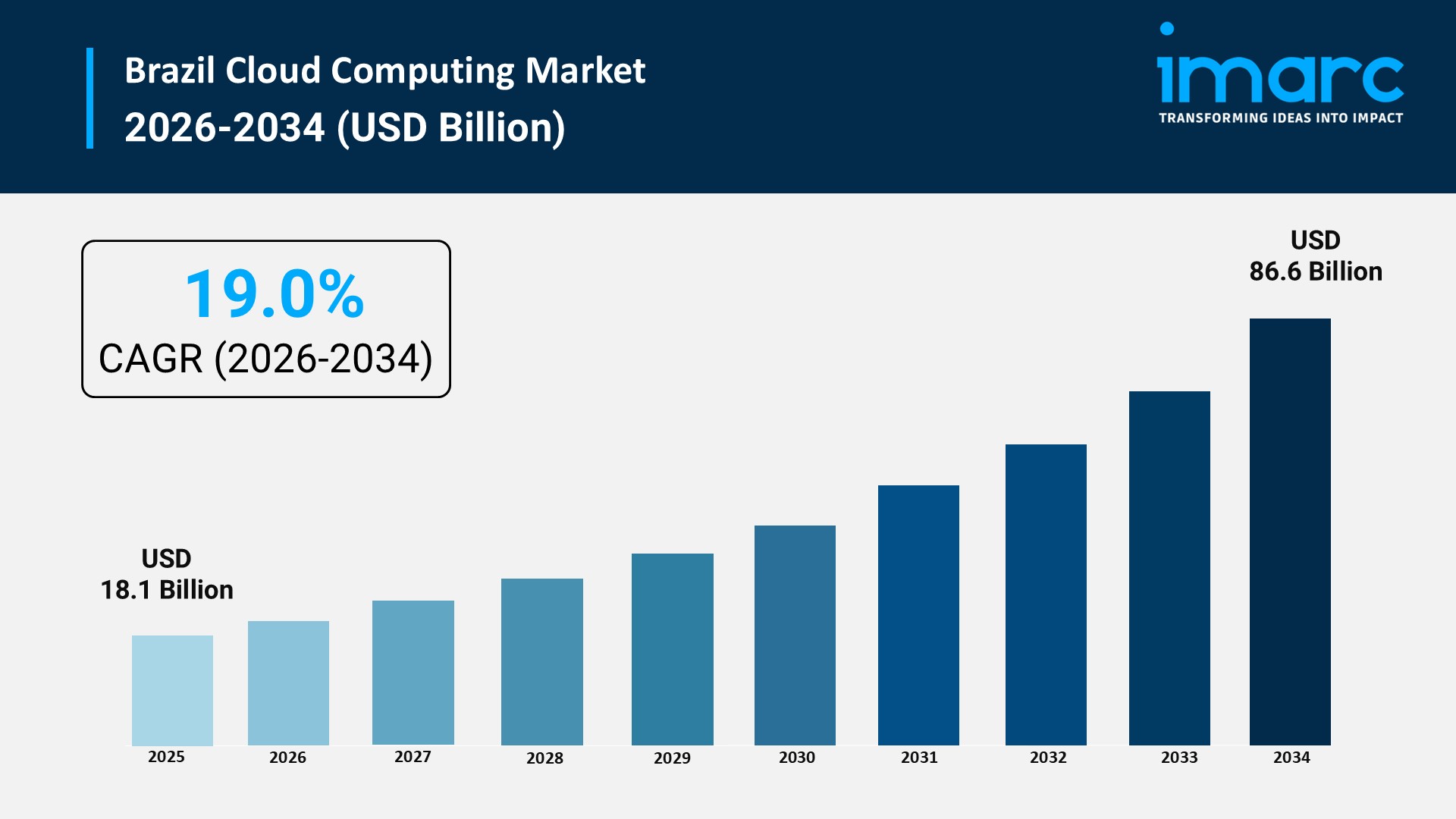
Brazil Cloud Computing Market to Reach USD 86.6 Billion by 2034 | CAGR of 19.00%
Cloud Computing Market
The Brazil Cloud Computing Market size reached 18.1 Billion in 2025 to reach 86.6 Billion by 2034 at a CAGR of 19.00% during 2026-2034 by IMARC Group
BRASíLIA, BRASíLIA, BRAZIL, February 25, 2026 /EINPresswire.com/ -- Brazil's cloud computing market is experiencing a powerful and sustained growth trajectory, valued at USD 18.1 billion in 2025 and projected to climb to USD 86.6 billion by 2034, according to a newly published report by IMARC Group. This remarkable expansion reflects a compound annual growth rate (CAGR) of 19.00% over the forecast period from 2026 to 2034. As Brazil continues to assert itself as Latin America's dominant digital economy, cloud computing has emerged as the foundational infrastructure enabling that transformation across industries and enterprise sizes.The scale of this opportunity is underscored by intensifying enterprise adoption, where Brazilian organizations - from multinational corporations to small and medium-sized businesses - are migrating legacy infrastructure to the cloud at an accelerating pace. The convergence of government-backed digitalization initiatives, surging mobile internet penetration, and the proliferation of data-intensive applications is creating an environment where cloud services are no longer optional but operationally essential.
Request for a sample to get detailed understanding about the market: https://www.imarcgroup.com/brazil-cloud-computing-market/requestsample
What is Driving Brazil Cloud Computing Market's Boom in 2026?
Government-Led Digital Transformation – Federal and state programs mandating cloud adoption, public service digitization, and improved data sovereignty regulations are creating strong baseline demand.
Rising SME & Startup Adoption – Growing startups and SMEs are shifting to scalable, cost-efficient SaaS and cloud platforms, reducing reliance on on-premise infrastructure.
Hyperscaler & Data Center Expansion – Increased local investments by global cloud providers, along with new data centers and availability zones, are reducing latency, ensuring LGPD compliance, and accelerating enterprise cloud migration.
Brazil Cloud Computing Market: Key Segment overview:
The following highlights the leading segments:
• By Service - Software as a Service (SaaS): segment listed; SaaS is a key service category alongside IaaS and PaaS
• By Deployment - Public Cloud: public, private, and hybrid deployment models covered
• By Workload - Application Development and Testing: segment listed among five workload categories
• By Enterprise Size - Large Enterprise: large enterprise and SME segments covered
• By End-Use - BFSI: nine end-use sectors covered including BFSI, IT and Telecom, Healthcare, and others
Detailed Segment Analysis
1. By Service: Software as a Service (SaaS) Dominates
Software as a Service (SaaS) holds the leading position within Brazil's cloud computing market by service type, and for compelling reasons rooted in the country's enterprise technology maturation cycle. Brazilian businesses across all sectors have rapidly embraced SaaS platforms as the most accessible and immediately deployable form of cloud technology, enabling organizations to subscribe to fully managed software applications without the complexity of infrastructure management. The SaaS model's subscription-based pricing structure resonates strongly within a market where capital allocation is carefully scrutinized, particularly among SMEs and mid-market enterprises seeking operational efficiency gains without large upfront IT investments.
Beyond SaaS, the market also encompasses Infrastructure as a Service (IaaS) and Platform as a Service (PaaS), both of which are gaining significant traction. IaaS is particularly favored by enterprises in the early stages of data center migration, while PaaS is attracting Brazil's developer community and technology-led startups building cloud-native applications. The combination of these three service models creates a comprehensive cloud services ecosystem that serves customers across every stage of their digital transformation journey.
Connect for detailed segmentation analysis, ask for analyst: https://www.imarcgroup.com/request?type=report&id=28880&flag=C
2. By Deployment: Public Cloud Leads the Market
Public cloud deployment commands the largest share of Brazil's cloud computing market, driven by its inherent advantages in scalability, cost optimization, and access to globally managed infrastructure. As hyperscalers such as AWS, Microsoft Azure, and Google Cloud continue to expand their Brazilian regional infrastructure, public cloud services have become increasingly aligned with LGPD data residency requirements - a factor that previously caused hesitation among regulated industries. The result is a surge in enterprise confidence in public cloud solutions, even among sectors traditionally bound by strict data governance frameworks such as financial services and healthcare.
Private cloud and hybrid cloud deployment models represent the other key segments of this market. Private cloud continues to attract large enterprises and government agencies with mission-critical workloads that demand dedicated infrastructure and granular security controls. Hybrid cloud, however, is emerging as the architecture of choice for sophisticated organizations that seek the scalability of public cloud while maintaining on-premise or private cloud environments for sensitive data processing - a model that is expected to see strong incremental growth through the forecast period.
3. By Workload: Business and Productivity Applications Command the Largest Share
Business and productivity applications represent the dominant workload category within Brazil's cloud computing market, reflecting the fundamental shift in how Brazilian enterprises equip their workforces with day-to-day operational tools. The mass adoption of cloud-based collaboration suites, enterprise resource planning (ERP) systems, customer relationship management (CRM) platforms, and human capital management (HCM) solutions has created a robust and recurring demand base for cloud infrastructure and services. This workload category has been significantly accelerated by the post-pandemic normalization of remote and hybrid work models across Brazilian corporations.
Additional key workload segments tracked in the report include storage and backup, compute, databases, networking, and analytics and intelligence workloads. Analytics and intelligence workloads are particularly noteworthy given Brazil's growing appetite for data-driven decision-making, artificial intelligence (AI), and machine learning (ML) applications. As Brazilian enterprises increasingly seek to derive actionable insights from the large volumes of operational and customer data they generate, cloud-based analytics platforms are evolving from a competitive advantage into a business necessity.
4. By Enterprise Size: Large Enterprises Lead with the Dominant Share
Large enterprises currently lead Brazil's cloud computing market by enterprise size, a reflection of their greater financial capacity, more complex IT environments, and longer-standing digital transformation roadmaps. These organizations have been the first to undertake comprehensive cloud migration strategies, often adopting multi-cloud and hybrid architectures that leverage multiple service providers simultaneously to optimize performance, cost, and risk management. Large enterprises in sectors such as financial services, retail, energy, and telecommunications have been particularly aggressive in their cloud investments.
The following sub-segments highlight the enterprise size landscape:
• Large Enterprises (Largest Share): Leading cloud adopters with sophisticated multi-cloud strategies, large IT budgets, and established vendor relationships with global hyperscalers.
• Small and Medium-sized Enterprises (High Growth): Rapidly growing sub-segment as SaaS and public cloud lower the barrier to entry, enabling SMEs to access enterprise-grade tools at affordable subscription costs.
Regional Spotlight: Where Is the Action?
Brazil's cloud computing market is characterized by a pronounced regional concentration in the Southeast, with the state of São Paulo functioning as the country's undisputed digital and commercial capital. São Paulo hosts the majority of Brazil's enterprise headquarters, the largest concentration of technology companies, and the primary data center infrastructure for the country's leading cloud service providers. The metropolitan region of São Paulo is the epicenter of cloud adoption, driven by its dense financial services ecosystem, large retail and consumer goods sector, and a thriving startup and fintech community.
• Southeast Brazil (São Paulo, Rio de Janeiro, Minas Gerais): The dominant regional cluster, accounting for the largest share of cloud computing spending, enterprise deployments, and hyperscaler infrastructure investments in the country.
• South Brazil (Paraná, Santa Catarina, Rio Grande do Sul): A growing region with a strong agribusiness, manufacturing, and technology cluster - particularly around Florianópolis and Curitiba - driving increasing cloud adoption for operational and supply chain applications.
• Northeast Brazil (Recife, Fortaleza, Salvador): An emerging innovation hub, anchored by Porto Digital in Recife and supported by government incentives, fueling cloud adoption among startups, tech companies, and public sector institutions.
• Central-West Brazil (Brasília, Goiás, Mato Grosso): Driven significantly by federal government digitalization programs and agribusiness modernization, with Brasília serving as the focal point for public sector cloud deployments.
• North Brazil (Amazon Region): The least mature cloud market sub-region, but one with long-term potential tied to infrastructure development programs and the digitalization of natural resource management and logistics operations.
Technology Is Redefining Brazil's Cloud Computing Operations
Artificial intelligence and machine learning are redefining what cloud computing means for Brazilian enterprises. Hyperscalers are embedding AI and ML capabilities directly into their cloud platforms, enabling Brazilian businesses to access generative AI tools, predictive analytics engines, and intelligent automation services without building bespoke AI infrastructure. This integration is particularly impactful in the BFSI sector, where AI-powered fraud detection, credit scoring, and personalized digital banking experiences are being delivered through cloud platforms at scale. The Brazilian government's growing interest in AI for public service optimization is further reinforcing this trend.
Edge computing is also beginning to reshape Brazil's cloud architecture, particularly in sectors characterized by geographically dispersed operations. Brazil's vast agricultural sector - one of the world's largest - is increasingly deploying IoT sensors across farms and supply chains, generating data that must be processed at or near the source before being transmitted to central cloud environments. Edge-cloud hybrid architectures are enabling precision agriculture, real-time logistics monitoring, and energy management solutions that were previously impractical given Brazil's diverse and often remote geographic landscape.
Key Players Shaping the Brazil Cloud Computing Market
The Brazilian cloud computing market features a competitive mix of global hyperscalers and regional technology providers, all competing aggressively to capture a share of one of Latin America's most dynamic and fastest-growing digital markets. The following companies are identified as key participants in the market landscape:
• Amazon Web Services (AWS)
• Microsoft Corporation (Microsoft Azure)
• Google LLC (Google Cloud)
• International Business Machines Corporation (IBM)
• Oracle Corporation
Challenges the Industry Must Address
Despite the strong growth outlook, key challenges remain:
• Data Privacy and Regulatory Compliance (LGPD): Brazil's Lei Geral de Proteção de Dados (LGPD), the country's comprehensive data protection legislation modeled on the European GDPR, presents ongoing compliance complexity for cloud service providers and their enterprise customers. Organizations migrating workloads to the cloud must ensure that data processing, storage, and cross-border transfer practices align with LGPD requirements, which demands significant investment in legal, technical, and operational compliance frameworks. The evolving regulatory landscape - including potential amendments and sector-specific data governance rules - creates an environment of regulatory uncertainty that can slow enterprise cloud migration decisions.
• Digital Skills Gap and IT Talent Shortage: Brazil faces a significant and well-documented shortage of cloud-skilled IT professionals, encompassing cloud architects, DevOps engineers, cybersecurity specialists, and data scientists. This talent gap constrains the pace at which organizations can design, implement, and manage cloud environments, particularly among mid-market and SME enterprises that lack the resources to compete for talent with large corporations. While cloud certification programs from AWS, Microsoft, and Google are expanding in Brazil, the pace of talent development continues to lag behind the rate of cloud adoption, creating a structural bottleneck for the market.
• Infrastructure Inequality and Connectivity Gaps: Despite Brazil's vibrant digital economy in major urban centers, significant infrastructure disparities persist across the country's vast interior regions. Limited broadband connectivity, unreliable power infrastructure, and high telecommunications costs in rural and remote areas create barriers to cloud adoption for agricultural enterprises, regional government entities, and businesses operating outside Brazil's major metropolitan areas. Addressing this geographic digital divide is essential to unlocking the full potential of the Brazilian cloud market across all five regions of the country.
About the Report
The Brazil Cloud Computing Market Size, Share, Trends and Forecast by Service, Deployment, Workload, Enterprise Size, End-Use, and Region, 2026–2034 report by IMARC Group provides comprehensive historical data, segmentation analysis, competitive landscape insights, and a forward-looking forecast through 2034.
The report covers multiple service types (SaaS, IaaS, PaaS), deployment models (public, private, hybrid cloud), key workload categories, 2 enterprise size segments, multiple end-use verticals including BFSI, healthcare, retail, IT & telecom, government, manufacturing, and others, and 5 regional markets across Brazil. Customization options are available, with 10% free customization included and 10–12 weeks of post-sale analyst support.
About IMARC Group
IMARC Group is a leading global market research company providing data-driven insights and expert consulting services to businesses seeking to achieve their strategic objectives. With a multi-disciplinary team of industry experts, IMARC delivers thorough, reliable market intelligence across sectors including information technology, cloud infrastructure, telecommunications, financial services, and enterprise software.
Elena Anderson
IMARC Services Private Limited
+1 201-971-6302
email us here
Legal Disclaimer:
EIN Presswire provides this news content "as is" without warranty of any kind. We do not accept any responsibility or liability for the accuracy, content, images, videos, licenses, completeness, legality, or reliability of the information contained in this article. If you have any complaints or copyright issues related to this article, kindly contact the author above.
